
Operator Library: Hardware Platform
このオペレーターは、QSFP28ファイバーポート経由の論理メタデータ受信リンクを表します。このリンクは選択されたポート内の特定のファイバーレーンを使用し、別のフレームグラバーから出力 O 上でメタデータを受信します。RX PHY のステータスは出力 LinkUp に提供されます。
DFRxMeta オペレーターは、AppletProperties オペレーターの FiberProtocol0 および FiberProtocol1 パラメーターが DataForwardingに設定されている場合にのみ使用できます。AppletProperties オペレーターの FiberProtocol0 および FiberProtocol1 パラメーターが CoFに設定されている場合、デザインルールチェック(DRC)によってエラーメッセージが出力され、DFRxMeta オペレーターの使用がブロックされます。
各 DFRxMeta オペレーターは、メタデータを受信するためにQSFP28ポート内の1つのレーンのみを使用できます。したがって、1つのQSFP28ポートで最大4つの DFRxMeta オペレーター(レーンごとに1つ)をサポートできます。このオペレーターは、通常非常にサイズが小さい高優先度のメタデータを伝送するように設計されています。
QSFP28 ファイバーポートは、合計 100 Gbit/s の帯域幅を提供し、4つのレーンに分割されます。各レーンは 25 Gbit/s で動作します。したがって、オペレーターは 25 Gbit/s で実行されます。
このオペレーターは、競合することなく DFRxData オペレーターと割り当てられたレーンを共有できます。ただし、複数の DFRxMeta オペレーター間でのレーン共有は許可されていません。
DFRxMeta オペレーターは特殊なプロトコルを必要としません。これは、2つのフレームグラバー(DFTxMeta [送信元、FG 1] と DFRxMeta [シンク、FG 2])間の論理リンクのエンドポイントとして機能します。QSFP28ポートやレーン構成を含め、リンク設定は両側で同一である必要があります。このオペレーターは小さなサイズのメタデータチャンクを転送することを目的としており、メタデータには画像構造がないため、リンクプロトコルは VALT_PIXEL0D になります。
![[注]](../common/images/admon/note.png) |
メタデータの優先度が高い |
|---|---|
|
メタデータチャネルは、DFRxData オペレーターからのデータチャネルよりも優先度が高くなります。両方のチャネルがデータの受信を待機している場合、メタデータが最初に処理されます。 |
メタデータチャネルを一時停止または停止することはできません。この意味で、O出力は無限のソースとみなす必要があります。受信側はすべてのメタデータを直ちに処理する必要があり、そうでない場合、データは失われます。この動作は、ファイバーリンク経由でのチャネルの優先度の高い伝送によるものです。メタデータチャネルは、極めて低いレイテンシと最小限のジッタ(クロックドメインの交差に起因する10 ns未満)を提供します。メタデータの転送に加えて、このチャネルを使用して正確なTimestampを送信したり、システム全体の同期を実装したりすることもできます。
データフォワーディングの詳細については、'Data Forwarding with imaFlex 2 Dual 100 Frame Grabbers'を参照してください。
| Available for Hardware Platform |
|---|
| imaFlex 2 Dual 100 |
リソース
オペレーターは、FiberConnectionパラメータの設定をダイアログに読み取り専用パラメータとしてミラーリングします。ダイアログをメニューから開くと、FPGAデバイスリソースを確認できます。デバイスリソースは読み取り専用です:
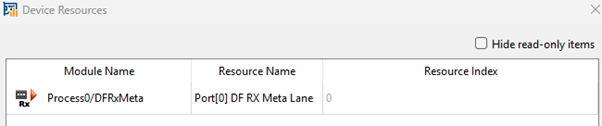
割り当てられたポートに応じて、リソースは Port[0] DF RX Meta Lane タイプ、またはインデックス範囲が0から3の Port[1] DF RX Meta Lane タイプになります。
| Link Parameter | Output Link O | 出力リンク LinkUp |
|---|---|---|
| Bit Width | 56 | 1 |
| Arithmetic | unsigned | unsigned |
| Parallelism | 1 | 1 |
| Kernel Columns | 1 | 1 |
| Kernel Rows | 1 | 1 |
| Img Protocol | {VALT_PIXEL0D} | {VALT_SIGNAL} |
| Color Format | VAF_GRAY | VAF_GRAY |
| Color Flavor | FL_NONE | FL_NONE |
| Max. Img Width | 任意(デフォルト: 16777216) | このパラメーターは動作中は無視されます。 |
| Max. Img Height | 任意(デフォルト: 16777216) | このパラメーターは動作中は無視されます。 |
O リンクは受信したメタデータをVisualAppletsに配信します。LinkUp リンクは接続ステータスを示します。LinkUp がアクティブな場合、ペアになっているTX側とRX側の両方がデータの送受信の準備ができている状態、つまり、リンクがトレーニング済みで稼働状態であることを意味します。
| FiberConnection | |
|---|---|
| タイプ | 静的書き込みパラメータ |
| Default | port_0_lane_0 |
| 範囲 | {port_0_lane_0, port_0_lane_1, port_0_lane_2, port_0_lane_3, port_1_lane_0, port_1_lane_1, port_1_lane_2, port_1_lane_3} |
|
このパラメーターは、データを受信するために DFRxMeta オペレーターによって使用されるQSFP28ファイバーポートとレーンを指定します。 選択された QSFP28 ポートは、そのポートの AppletProperties オペレータ内の FiberProtocol パラメータが CoF ではなく DataForwarding に設定されている場合にのみ使用できます。 FiberProtocol が CoF に設定されており、DFRxMeta オペレーターがそのファイバーポートへのマッピングを試みると、デザインルールチェック(DRC)によってエラーメッセージが生成されます。この場合、FiberConnection パラメーターは競合状態(赤色)としてマークされ、その上にカーソルを合わせると競合を説明するクイックティップヘルプメッセージが表示されます。 同じレーン上の同じハードウェアQSFP28ポートを使用できる DFRxMeta オペレーターは1つだけです。複数のオペレーター間のマッピングは、デザイン全体で一意である必要があります。 |
|
オペレーター DFRxMeta の使用方法は、次の例に示されています。
-
「imaFlex 2 Dual 100 プラットフォーム上の Data Forwarding」
これらの例は、imaFlex 2 Dual 100 プラットフォーム上でデータ転送をどのように実装できるかを示しています。
 前へ
前へ

